

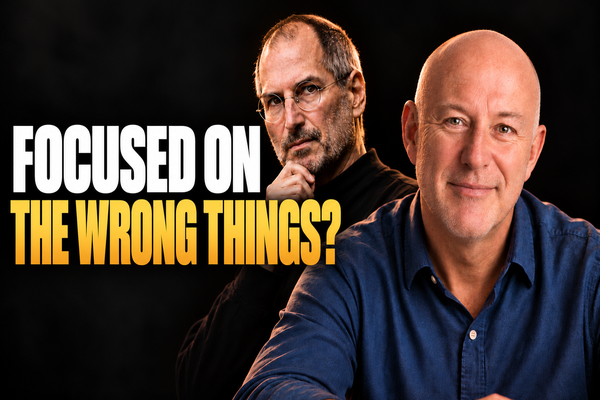
What If You're Getting Better at the Wrong Things?
Focus is important. But what if we're focusing on the wrong things?
1. Introduction
We can work hard, become more productive, and get better at what we do—without necessarily moving forward on what matters most.
Steve Jobs famously spoke about focus as saying no to a thousand things. But before we decide what to say no to, we need to be clear about what deserves our attention.
In this video, we explore the difference between focus and clarity, what we can learn from Steve Jobs, and why doing more isn't always the answer.
2. Watch the Video
What If You're Getting Better at the Wrong Things?
[Embed YouTube video here]
3. The Key Idea
Focus helps us stay with the work. Clarity helps us see which work is worth doing.
Being productive isn't enough if we're working on the wrong things.
We can become faster and better at activities that no longer create much value.
Before asking how to get more done, we need to ask whether we're giving our attention to what matters most.
Three useful definitions:
Signal is what matters most.
Noise is what gets in the way.
Clarity is what helps us see the difference.
4. Three Insights
1. Even good ideas can become noise
Not all noise comes from meetings, emails, and interruptions.
Some of it comes from ourselves.
New ideas, opportunities, projects, and strategies can all seem worthwhile. But when they compete with our most important goals, even good ideas can get in the way.
The challenge is to stop, simplify, and choose what deserves our attention.
2. Pushing harder isn't always the answer
When a team is busy but progress is slow, leaders may respond with more follow-ups, reporting, and control.
But what if the team is already struggling with unclear priorities, conflicting instructions, or constant interruptions?
Adding more demands may only make things worse.
Before pushing harder, we need to understand what's actually getting in the way of people doing their best work.
3. Clarity must come before focus
Steve Jobs demonstrated the value of making difficult choices about what deserves attention.
When he returned to Apple, he dramatically simplified the company's product range, concentrating on a much smaller number of products.
The lesson isn't simply to say no more often.
It's to become clear about what you want to create, what will move you forward, and what you're willing to leave behind.
And that clarity needs to be revisited as circumstances change.
5. Questions & Answers
What's the difference between clarity and focus?
Clarity helps us understand what matters most and what deserves our attention. Focus helps us direct and sustain our attention on it.
Without clarity, we risk becoming very productive at the wrong things.
What did Steve Jobs teach us about focus?
Jobs emphasized that focus means making choices and saying no to many things, including potentially good opportunities.
His approach at Apple demonstrated how concentrating resources on a few important priorities can create room for better work.
How do you distinguish signal from noise at work?
Start by asking what truly moves your most important goals forward.
Signal is what matters most. Noise is what gets in the way.
Noise may include unnecessary meetings, unclear priorities, constant interruptions, or even attractive ideas that distract from your main goals.
Why can a team be busy but make little progress?
Because activity and progress aren't the same thing.
A team can spend enormous energy responding to demands without making meaningful progress on its most important work.
Unclear priorities, conflicting expectations, and frequent interruptions can contribute to this.
How can leaders create more clarity in their teams?
Start by understanding what's really getting in the way.
Ask people what helps them do their best work, what gets in the way, and which activities actually move the team's goals forward.
Then agree on what deserves more attention—and what can be reduced or stopped.
How can we make sure we're focusing on the right things?
Regularly revisit your priorities and ask whether they still support what you want to achieve.
Three useful questions for a team conversation are:
What did we do this week that truly moved our most important work forward?
What do we need to do more of?
What do we need to do less of?
Give people time to reflect before answering. Different perspectives may reveal something important.
6. Next Step — Create More Room for What Matters
Is your team working hard but not making the progress you know is possible?
The Team Clarity Report helps leaders see what's working, what's getting in the way, and what to change first.
Through confidential team questionnaires, we explore clarity, focus, and the room people have to do their best work.
The goal isn't to push people harder. It's to create better conditions for clear thinking, good decisions, and meaningful progress.
Explore the Team Clarity Index:https://wetterholm.com/teamclarityindex
Less noise. Room to matter.
7. Full Video Transcript
What If You're Getting Better at the Wrong Things?
Steve Jobs said no to a thousand things. Could you?
There is a war going on for our attention. And it's far too easy to give it away to things that don't truly matter.
So if we want to create anything of value—at work or in life—we need to separate what moves us forward from what is just noise that keeps our attention busy.
Steve Jobs was a master of focus. He said focus means saying no to a thousand things.
In this video, we'll hear Kevin O'Leary describe Jobs's approach to separating signal from noise—and explore what we can take away from it.
But we also need to ask ourselves: let's say we get all focused—what if we're focusing on the wrong things?
What if we're getting better at something that doesn't really matter?
Maybe focus isn't really the whole story?
So what are we missing here?
Busy or Making Progress?
I'm Stefan Wetterholm. I've worked closely with more than 1,000 people through in-depth leadership programs lasting up to one year.
Again and again, I saw what happened when the noise cleared: thinking deepened, decisions improved, and many started performing at a whole new level.
This is now my focus: to help create less noise. Room to matter.
There are many traps in today's workplace.
We can work hard all week. Meetings, emails, things that need our attention.
But when we stop and look back—did we just keep busy, or did we actually move the needle on what matters most?
There is a lot of external noise competing for our attention—but there's also internal noise.
For example, with a brain like mine, I can come up with new ideas and strategies every day of the week.
Another project. Another strategy. Another service.
My challenge in handling my internal noise is to stop, simplify, and focus.
Because even good ideas can become noise when they're not attached to my main goals.
The Cost of Focusing on the Wrong Things
When a team is busy but progress is slow, I've often seen leaders respond by just pushing harder.
More follow-ups. More reporting. More control.
Sometimes it may be needed, but most of the time it also restricts the energy.
So before we rush and push harder, we need to understand what's actually getting in the way of people doing their best work.
Are they unclear about the priorities?
Are they receiving conflicting instructions?
Are they constantly interrupted?
Or have they lost trust in what we are doing?
If we don't understand the situation more deeply, we might be adding more demands to a team that already has too many.
We keep shaking the globe—and then ask people to do more.
This is where separating signal from noise becomes useful.
Listen to how Kevin O'Leary describes the lesson he took from working with Steve Jobs.
[Kevin O'Leary video clip]
There's real value in this.
Choose the things that really matter. Give them your full attention. And start saying no to everything else.
Jony Ive, Apple's chief designer for many years, speaking about focus and what he learned from Jobs, put it like this:
"This sounds really simplistic, but it still shocks me how few people actually practice this."
That's something I have to remind myself of.
I can't give every new idea my attention and expect the most important ones to move forward.
What If Your Focus Is Wrong?
Now, what if we follow this advice perfectly—and focus on the wrong things?
We become faster and more productive at work that no longer creates much value.
So what's missing?
Focus helps us stay with the work. Clarity helps us see which work is worth doing.
Signal, Noise, and Clarity
My definition is:
Signal is what matters most.
Noise is what gets in the way.
Clarity is what helps us see the difference.
There are also levels of clarity.
There is extensive research done on how differently we see, understand, and act depending on the level of clarity we operate from.
Clarity can be trained. More about that in another video.
What Becomes Possible When We Get Clear?
So what can we learn from using Jobs's signal versus noise approach and by adding clarity?
One takeaway is—more action isn't always the answer.
Instead, it might be to take our time to first become clear and choose our goals and signals really carefully by asking:
What do we really want to create—and what deserves our full attention?
What do we have to let go of or say no to, to focus fully?
You've probably heard the story of Jobs returning to a bleeding Apple, replacing 17 computer models, licensed vendors, and many other projects with a simple two-by-two grid.
Two products for consumers and two for professionals.
And then he said no to the rest.
Not necessarily because the products weren't good, but because they didn't support where he wanted to take the company.
If this is where you're at, you might want to ask yourself:
What makes us unique, and what can we become the best in the world at?
And then dare to say no to the rest.
It's important to note that this is not a job you do once and then you're done.
It's a daily re-evaluation and recalibration of what's most important, depending on new input and events.
Remember, it's said that 100 years ago, many top executives and professionals took naps in the middle of the day to feel refreshed and travelled extensively to get new input.
Maybe they knew something we have forgotten.
We can ask ourselves how much of our work is actually unnecessary and could be done in some better way, or by somebody else, so that our people could focus on what's most important and create higher value with their work.
For this, there is a shift needed.
Instead of being satisfied with the team being busy, asking ourselves: what is our work actually achieving?
This is when clarity—what we see and understand—becomes a leader's main focus.
And from there, deciding what the right action is.
Three Questions for Your Next Team Conversation
I'll leave you with three questions for your next team conversation:
What did we do this week that truly moved our most important work forward?
What do we need to do more of?
What do we need to do less of?
Give people time to reflect before they answer.
You may even have different views about what matters most.
This is a worthwhile discussion to have before everyone just goes back to working hard.
In the comments, tell me: What have you given your attention to that no longer deserved it? And what did you focus on instead?
If you'd like more ideas on how to protect attention and do your best work, subscribe.
If you want to work together, there is a link in the description.
Want to make more room for your most important work? Watch this video next.
See you in the next video.